Where is the accepted hand-off?
Record the exact position, height, datum, orientation, pitch and condition in which the part becomes the receiving machine’s responsibility.
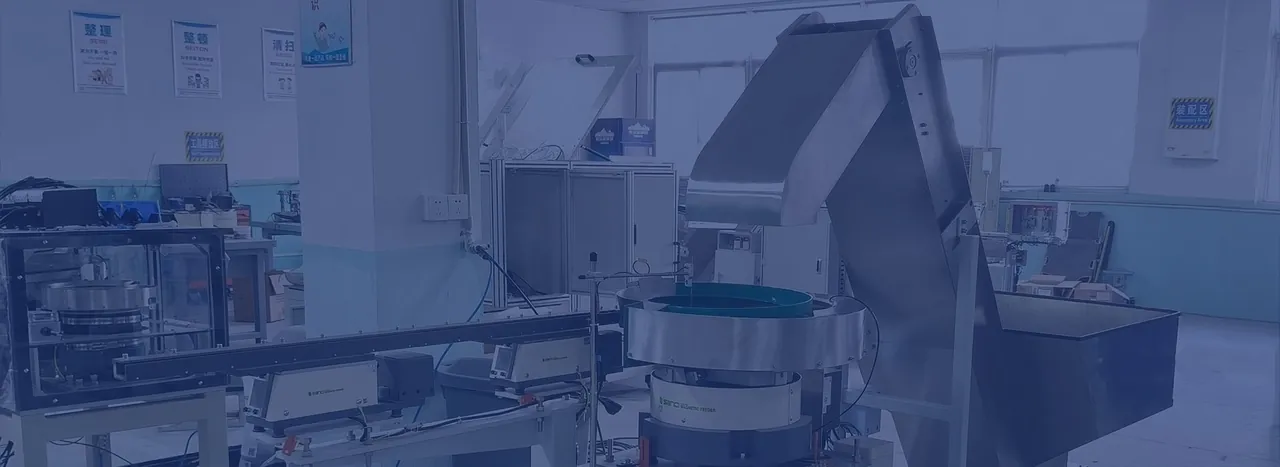
RETROFIT & LINE INTEGRATION
Connect bulk loading, orientation, buffering and release to an existing assembly or packaging machine through a defined mechanical, controls and safety interface.
DIRECT ANSWER
Parts feeder integration makes the new feeding cell and the receiving machine operate as one recoverable production sequence.
The scope normally covers discharge height and datum, component pitch, buffer capacity, sensors, demand and ready signals, PLC ownership, guarding, safe access, fault recovery, factory testing, installation and commissioning. A reliable retrofit is defined at the hand-off—not at the feeder outlet alone.
INTEGRATION REVIEW
Accurate interface information reduces site changes, shutdown risk and late responsibility gaps.
Record the exact position, height, datum, orientation, pitch and condition in which the part becomes the receiving machine’s responsibility.
Use real cycle timing, micro-stops, planned pauses and changeovers to define accepted output and useful accumulation.
Confirm available I/O, network options, recipe ownership, alarm handling and who is permitted to modify legacy software.
Define guarding interfaces, stops, interlocks, reset zones, access and responsibility for changes to the existing machine.
Protect operator loading, tooling access, cleaning, jam clearance, changeover and maintenance routes in the final layout.
Plan survey, pre-build, offline tests, installation, commissioning and fallback around the production window.
COMMON RETROFIT RISKS
The table turns typical retrofit surprises into information that can be checked before manufacture.
| Risk | Evidence to obtain | Design response |
|---|---|---|
| Unstable machine demand | Cycle trace, stop frequency and restart behaviour | Size the buffer and replenishment logic around sustained production |
| Unverified hand-off geometry | Measured datum, access envelope and sample at transfer | Freeze a signed interface drawing before tooling manufacture |
| Legacy controls limitations | PLC type, spare I/O, networks, backups and software ownership | Choose a clear signal boundary or an agreed controls modification |
| Queue pressure and part damage | Part finish, allowable contact and maximum accumulation | Control bed depth, guide pressure, recirculation and stop sequence |
| Unsafe recovery access | Likely jams, reach points and current risk assessment | Provide guarded access, isolation and a defined recovery method |
| Insufficient commissioning time | Shutdown plan and production acceptance window | Maximise offline FAT and prepare interface checks before site |
DELIVERY ROUTE
A staged plan protects production while preserving a measurable acceptance route.
Gather layouts, component information, controls details, production states and the proposed responsibility boundary.
Agree the hand-off, buffer, layout, I/O schedule, safety concept, access and shutdown assumptions.
Prove feeding, orientation, accumulation, release, alarms and recovery against representative parts.
Confirm utilities, foundations, lifting, cable routes, isolations, permits and the existing-machine readiness checklist.
Connect the mechanical and electrical interfaces, validate handshakes and tune the complete production sequence.
Train operators and maintenance teams, close agreed actions and record the final settings and documentation.
COMMON QUESTIONS
Final suitability depends on the real components, the existing equipment and an agreed interface review.
Usually, subject to a review of the physical hand-off, available space, component demand, buffer requirement, electrical and PLC interfaces, guarding and responsibility for modifications to the existing machine.
Useful information includes the receiving-machine layout, hand-off position, component family, target sustained rate, current controls platform, available I/O, safety arrangement, access constraints and the production downtime available for installation.
Feeding, orientation, buffering and much of the controls sequence can normally be tested during factory acceptance. Final confirmation of the physical and electrical interfaces requires accurate site data and commissioning with the receiving machine.
The design combines a measured sustained feed rate, suitable accumulation, level and part-present sensing, demand signals and defined stop and restart logic so the two machines operate as one sequence.
EXISTING MACHINE REVIEW
Send the existing machine layout, component family, target output and available integration window for an initial review.
A product change can leave components in places that the main hopper level sensor cannot see: return chutes, linear tracks, escapements and the receiving machine. When integrating a feeder into an existing line, agree where the old batch ends and who confirms that each remaining component has been accounted for before the new recipe is released.
Prepare a simple map of every storage and return point. For each location, identify whether remaining parts are run through, collected through a designed emptying route or removed under the approved access procedure. Include the receiving machine in the review; clearing the feeder alone does not clear a downstream nest. Where similar variants share tooling, distinguish quantity clearance from confirmation of the correct component identity.
Include a realistic product change in the acceptance trial. Record the old and new part references, recovered material, inspection checks and first accepted hand-off. This makes changeover time useful for production planning and exposes awkward access before installation. Send your two most easily confused component variants with the existing machine layout so the clearance and identity checks can be considered together.
No. Parts can remain in return chutes, tracks, escapements and the receiving machine. Agree how every retention point is checked.
Yes when the installation will share formats. The trial should confirm clearance, recipe selection and the first accepted part of the new run.
Plan feeding for multiple product variants Prepare the integration specification