Clips and retainers
Asymmetry can support orientation, while flexible legs, interlocking and cosmetic contact require controlled bulk depth and tooling.
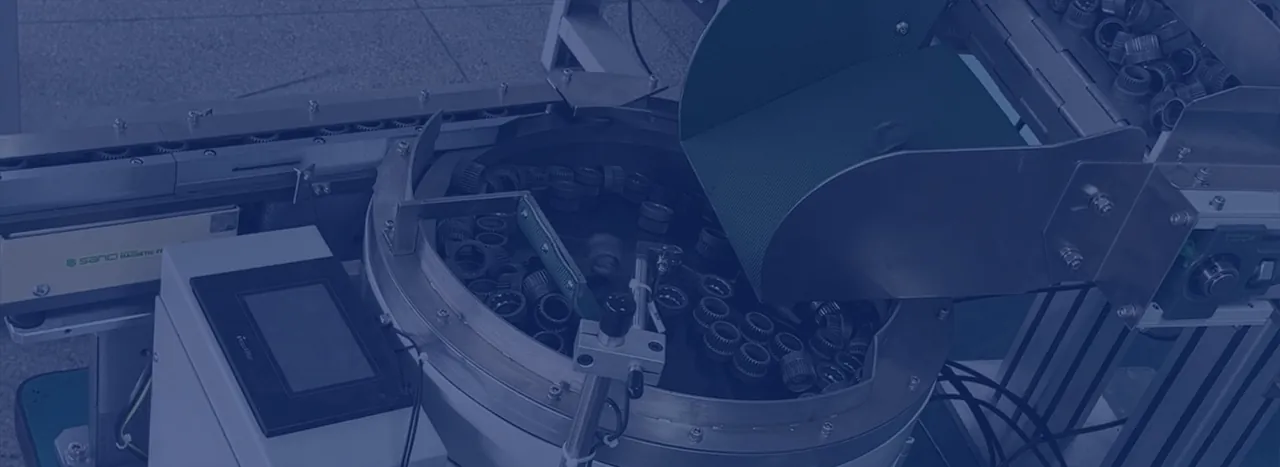
AUTOMOTIVE ASSEMBLY INPUT
Orient, inspect, buffer and present clips, fasteners, connectors, seals and moulded parts at the exact condition your assembly process requires.
DIRECT ANSWER
It controls the component from bulk supply to an accepted, traceable hand-off at the assembly process.
A complete cell may include ergonomic loading, metered replenishment, orientation, feature or variant checks, rejection, accumulation, escapement, blow-feed or robot presentation, PLC/HMI controls, guarding and connection to the production line. The engineering target is sustained accepted supply through normal model changes, stops and recovery.
COMPONENT FAMILIES
Samples should include expected production variation, not only nominal CAD geometry.
Asymmetry can support orientation, while flexible legs, interlocking and cosmetic contact require controlled bulk depth and tooling.
Separate nested or stacked parts, verify head or thread direction, then manage the route to a driver, press or pick point.
Protect delicate latches, seals and contact areas while differentiating similar variants and maintaining presentation accuracy.
Control contamination, distortion, overlap and static while defining how an accepted seal reaches the insertion process.
Tangling, telescoping, rolling and unstable orientation make sample trials and controlled recirculation important.
Consider flash, gate condition, cavity variation, surface marking and changes in geometry across model derivatives.
VARIANT ASSURANCE
Controls should match the real variant risk and the reliability of the available differentiating feature.
| Control layer | Purpose | Project question |
|---|---|---|
| Bulk input control | Reduce the chance of loading the wrong container | Can container identity, location or operator selection be verified? |
| Recipe permission | Align feeder, inspection and line settings | Which PLC owns the model and what happens on a mismatch? |
| Tooling identification | Confirm installed change parts suit the selected component | Are keyed tooling, coded parts or sensors appropriate? |
| Component inspection | Check orientation or a distinguishing feature | Can every acceptable part be separated reliably from the wrong variant? |
| Reject confirmation | Verify a suspect part left the accepted route | How is a failed or uncertain reject handled? |
| Line traceability | Record relevant production events where required | Which data, timestamps and retention are genuinely needed? |
LINE AVAILABILITY
Output is valuable only when the whole line can use it consistently.
Size accumulation around normal cycle variation and micro-stops without creating excessive pressure or hidden queues.
Tell the operator whether the cell needs bulk parts, is starved, blocked, waiting on the line or has a true equipment fault.
Provide safe access to likely misfeed and changeover locations without dismantling unrelated equipment.
Define how queued parts, reject status and the receiving station are checked after stops or an open guard.
Make wear items, sensors, air services and adjustment references accessible and document approved settings.
Identify critical custom and bought-out items, backups and support contacts before production handover.
LAUNCH & CHANGE
A robust project plan separates nominal throughput from the variation likely to appear after launch.
| Evidence | Why it matters | What to supply |
|---|---|---|
| Variant matrix | Prevents unpriced formats and ambiguous future provision | Part numbers, drawings, revisions and expected launch dates |
| Representative samples | Reveals tangling, finish and dimensional behaviour | Multiple batches, cavities and known difficult acceptable parts |
| Demand profile | Defines sustained output and useful buffering | Cycle data, model mix, planned stops and shift pattern |
| Line interface | Closes mechanical and controls responsibilities | Layout, datum, PLC/network details and safety boundary |
| Acceptance plan | Creates a shared definition of production readiness | Test duration, sample mix, interventions, quality and handover checks |
COMMON QUESTIONS
Final suitability is established against real component and line data.
Potential applications include clips, pins, screws, nuts, washers, connectors, terminals, seals, springs and moulded components. Suitability depends on the actual geometry, condition, variant range, required presentation and production process.
Inspection can be incorporated for suitable differentiating features, orientation or presence checks. The required detection, reject confirmation, traceability and response to an uncertain result should be defined and proven with representative parts.
The approach may combine recipes, sensors or vision, keyed change parts, tooling identification and line permission signals. The appropriate controls depend on the number of variants and the consequence of loading or presenting the wrong component.
Yes, following a review of the physical hand-off, cycle demand, accumulation, PLC and network interfaces, safety boundary, available space, access and production shutdown window.
AUTOMOTIVE PROJECT REVIEW
Send the variant list, representative components, production rate, layout and controls requirements for an initial review.