Product-contact definition
Identify surfaces that contact the component and specify relevant materials, finishes, lubrication and permissible marking.
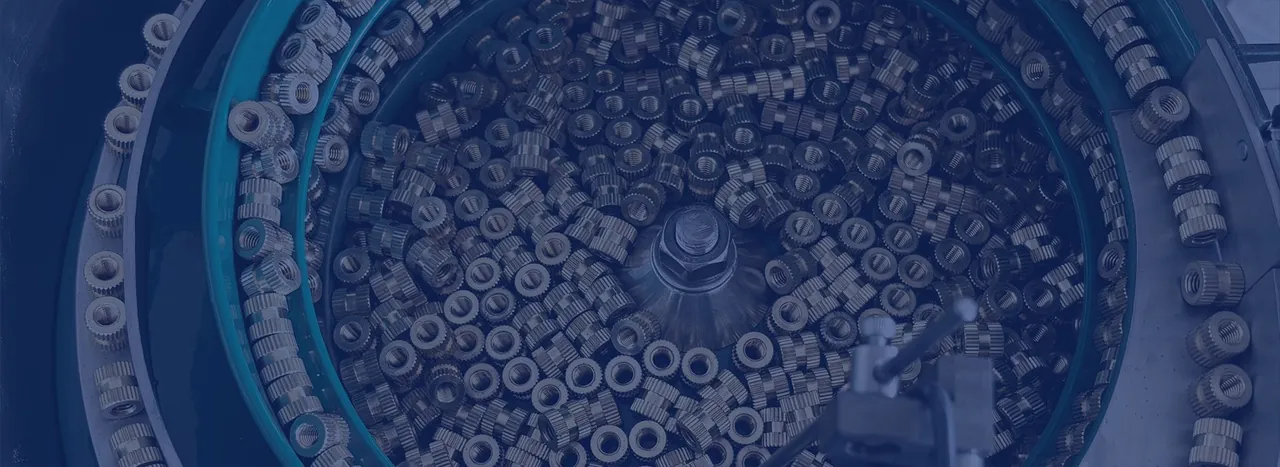
MEDICAL DEVICE ASSEMBLY INPUT
Engineer handling, inspection, change control and production presentation around the component, environment and customer-defined acceptance plan.
DIRECT ANSWER
It separates and presents components to an assembly process while controlling the handling and evidence defined for the project.
A complete cell may include ergonomic bulk loading, controlled orientation, component protection, inspection, confirmed rejection, buffering, precision hand-off, PLC/HMI controls, guarding, cleaning access and documented factory acceptance. The equipment scope must align with the manufacturer’s quality, validation and change-control plan.
REQUIREMENT AREAS
Cleanability, component protection and documentation mean different things unless converted into testable requirements.
Identify surfaces that contact the component and specify relevant materials, finishes, lubrication and permissible marking.
State the cleaning agent, frequency, access, removable parts, inspection and customer acceptance method.
Review ledges, gaps, recirculation paths and wear points against the actual component and environment requirement.
Limit drop, impact, compression, recirculation and contact with functional or cosmetic features.
Define the features, sample population, decision limits, uncertain-result response and confirmed reject route.
Agree drawings, manuals, software versions, test records, parts lists, training and final revision handover.
COMPONENT BEHAVIOUR
Medical device components can be light, flexible, sharp, interlocking or sensitive to repeated contact.
| Behaviour | Project concern | Design or test focus |
|---|---|---|
| Tangling or interlocking | Unstable replenishment and possible deformation | Bulk depth, metering, separation route and recovery |
| Soft or flexible parts | Compression, stretching or false sensor response | Contact force, guide geometry, accumulation and sensing trials |
| Delicate functional features | Damage not always visible during operation | Drop heights, recirculation limits and agreed post-test checks |
| Transparent or reflective material | Inconsistent optical detection | Lighting, contrast, alternative sensors and representative batches |
| Small dimensional differences | Variant or defect discrimination | Measurement capability, controlled presentation and uncertainty route |
| Particulate sensitivity | Wear debris or retained contamination | Materials, finishes, clean access, maintenance and inspection points |
INSPECTION & REJECTION
Every automated check needs defined good, bad and uncertain outcomes.
State whether the check confirms orientation, presence, assembly feature, variant or another visible characteristic.
Provide representative conforming variation plus controlled examples of the conditions the check is expected to detect.
Control the component pose, viewing zone, background, lighting and movement before evaluating the feature.
Define pass, fail and uncertain responses, including stop conditions and the permissions needed to resume.
Separate and confirm rejected components so they cannot re-enter the accepted path without an authorised route.
Agree the data, alarms, audit events and software version information the customer’s process actually requires.
DOCUMENTED DELIVERY
The customer’s quality team can then decide how supplied evidence fits the wider process lifecycle.
| Stage | Agree | Possible project record |
|---|---|---|
| User requirement review | Functions, constraints, responsibilities and acceptance | Requirement and compliance matrix |
| Design review | Material route, access, controls, safety and interfaces | Approved drawings, risk actions and design decisions |
| Software and recipes | Ownership, permissions, backups and change method | Functional description and version record |
| Factory acceptance | Samples, conditions, duration, interventions and results | Signed test sheets, data and open-action list |
| Installation and handover | Readiness, site checks, training, final revisions and spares | Commissioning record and document pack |
COMMON QUESTIONS
Customer-specific regulatory, environmental and quality requirements should be stated at the start of the project.
Potential applications include caps, closures, housings, plungers, seals, needles or cannula-related parts, springs and small moulded components. Suitability and handling controls depend on the actual component, process, cleanliness requirement and customer risk assessment.
Yes. The project can define accessible product-contact areas, removable tooling, material and finish requirements, drainage or particle traps where relevant, and documented cleaning access. The customer should specify the cleaning method and acceptance requirement.
Suitable visible features, orientation or presence can be checked, with a controlled reject path and result handling. Inspection feasibility and performance must be established against representative good, bad and variable samples.
No. Factory acceptance demonstrates the agreed equipment functions under defined test conditions. The manufacturer remains responsible for its regulatory, quality-system and process-validation obligations, with equipment evidence incorporated into its own plan as appropriate.
MEDICAL DEVICE PROJECT REVIEW
Send the component family, samples, environment, output, hand-off and customer-defined acceptance needs for an initial review.