Automatic screwdriving
Singulate, confirm and blow or place one screw at the driver without thread damage or doubles.
ASSEMBLY AUTOMATION
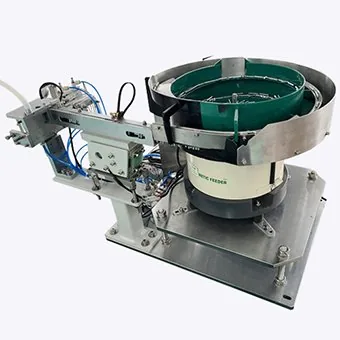
Complete feeding systems for automated drivers, presses, insertion stations, robots and controlled operator assembly.
REPEATABLE ASSEMBLY INPUT
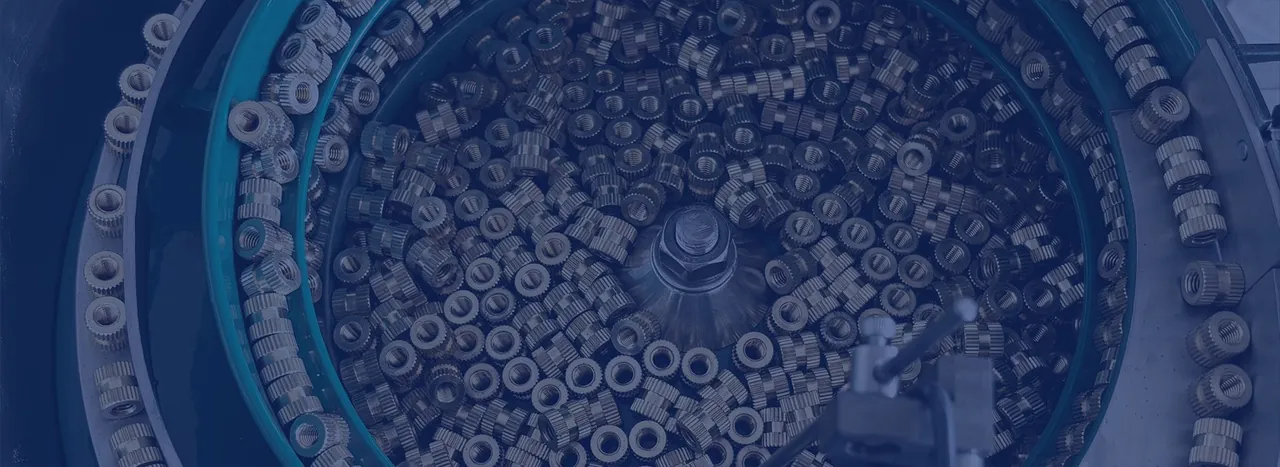
Screws, nuts, washers, pins, rivets, bushes and inserts can tangle, overlap, nest or arrive in several stable attitudes. The feeding cell must control these behaviours before the assembly cycle calls for a component.
The final presentation may be a blow-feed tube, shuttle, escapement, precision pick point, nest or insertion tool. Each route creates different demands for orientation, buffer pressure, sensing and fault recovery.
STATION INTERFACES
The most critical tooling often sits between the end of the track and the assembly operation.
Singulate, confirm and blow or place one screw at the driver without thread damage or doubles.
Present pins, bushes, seals or inserts to a fixed nest or robot at a repeatable datum.
Create a known pick face, verify availability and give the robot clean gripper access.
Deliver counted or one-at-a-time components to an ergonomic, sensor-confirmed pick point.
Coordinate several feeders, buffers and station requests through one cell controller.
Use presence, height, orientation or selected feature checks before release to the station.
FASTENER FEEDING RISKS
The feeder must manage the difficult part population, not only the easiest samples. Long shanks, open features, burrs, mixed sizes, oil and damaged threads can all destabilise automatic presentation.
SEVERAL ASSEMBLY INPUTS
A multi-component cell must coordinate each feeder, buffer, verification point and recipe around the complete build sequence. The slowest or least stable feed path determines the usable cycle.
PROJECT ASSESSMENT
We will help define the right starting architecture, the evidence needed for selection and the interfaces that belong in the project scope.